
Abdullah said he knows only of his son Omar Abdullah and another former CM Mehbooba Mufti's arrest that too through the media.

The BJP has already cobbled up 28 seats to counter-bargain with the PDP's 28 seats in future talks. It is up to the Kashmir-based parties like the National Conference and PDP to assess the damage of going with the BJP which is perceived as the 'Hindu' party in the state. Sheela Bhatt/Rediff.com's takeways from a historic but fractured mandate in Jammu and Kashmir.

"It would be my hope that people understand why this particular transaction is important for us," the EAM said in Washington, DC.
The Attorney General said whatever is being said by this court is sent before the United Nations.

Gen Rawat said, while addressing a gathering at a health summit, leaders emerge from crowds but are not those who lead people in 'inappropriate directions'.
In two and a half years, first PM-like action by Modi: Rahul Gandhi on India's surgical strikes
Breaking his silence on the over-a-month-long unrest which has claimed more than 55 lives, Modi said it was painfully to see innocent youngsters, who should be holding laptops, book and cricket bats, have been given stones

Khan said Kashmir is the 'core' issue between the two countries and it should be resolved through talks.
One priority for Delhi (for the new foreign secretary in particular) is to have an in-depth discussion with Dharamsala as soon as possible, suggests Claude Arpi.
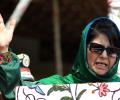
"When the people of BJP (Bharatiya Janata Party) talk of Article 370, they talk of technical integration. We have to make them understand that we also want that Jammu and Kashmir should fully integrate with India emotionally," she said.

In its short history, Pakistan has become a geography synonymous with terror.
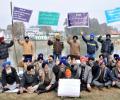
APSCC Chairman Jagmohan Singh Raina talks about the life and times of the Sikh minority in a politically tumultuous region of Jammu & Kashmir.

Bharatiya Janata Party General Secretary Ram Madhav on Friday said his party was holding consultations with all important stakeholders in Jammu and Kashmir for providing a stable government.

It has been obvious that the Sino-Pak axis would conspire to weaken India's sovereignty in Jammu and Kashmir, if not wrest Kashmir, says David Devadas.
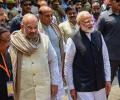
Almost all prominent leaders of the Bharatiya Janata Party, as well as members of the National Democratic Alliance and North-East Democratic Alliance accompanied Modi.

'India need to look beyond the economic prism.' 'China had no qualms in taking the Kashmir issue to the UN Security Council last year -- not once, but thrice -- thus violating Indian sensitivities,' observes China expert Srikanth Kondapalli.
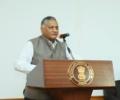
"The friendship between China and Pakistan appears to be very strong but the day is not far when China too gets affected by Pakistan-backed terrorism," Singh, who is in Gorakhpur to take part in a function at the Gorakhnath temple, told media persons on Monday night.
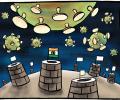
No nation is fully sovereign to do what it wants to do in the face of opposition from others, points out Aakar Patel.

'A firm national resolve can only deter and defeat the nefarious designs of the adversary,' notes Rup Narayan Das.

Dr Behera speaks about how the nationwide positive reaction to the abrogation of Article 370 in Jammu and Kashmir indicates that the very idea of India is changing. From a diverse, multicultural entity, could India be becoming a place where assimilation is more important than accommodation?

May told the House of Commons that the UK remained in regular contact with both countries and was working towards de-escalating tensions.
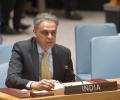
Strongly hitting back at Pakistan for raising in the United Nations the issue of the killing of Hizbul commander Burhan Wani, India has said Pakistan "extols" the "virtues" of terrorists and uses terrorism as a state policy towards the "misguided end" of coveting the territory of others.

He challenged the Congress to select someone 'capable' as its president, who did not belong to 'that one family'.

The motion takes note of the UNHCR statement last month, which described the CAA as 'fundamentally discriminatory in nature', and also of other United Nations as well as the EU guidelines on human rights as it calls on the Indian government to 'repeal the discriminatory amendments'.
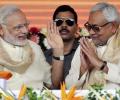
The Janata Dal-United, an ally of the Bharatiya Janata Party, opposed the government's move on Article 370 through a fresh Presidential Order ending special status to Jammu and Kashmir. On Monday, opposing the Narendra Modi-led government's decision, they walked out of the Rajya Sabha where the bill to split the state into two Union Territories was passed. Similarly, on Tuesday, the JD-U walked out of Lok Sabha while the bill was being discussed. In Patna, JD-U national spokesperson K C Tyagi said: "We completely differ with the Central government's move on Jammu and Kashmir. There was a need for wider consultations on it, but no consultation was done even within the NDA. We own the legacy of socialist leaders Ram Manohar Lohia and Jai Prakash Narayan, who had opposed attempts to tamper with Article 370 during Congress (government in the past)." Speaking to Syed Firdaus Ashraf/Rediff.com on the same, the JD-U leader said that 'walking out of Parliament won't affect their ties with the Bharatiya Janata Party'.

Two months ago, May 2, Major Anuj Sood made the supreme sacrifice for the motherland in a hostage-rescue mission in J&K. As his grieving family grapples with their immense loss, they graciously share memories of the young major -- a husband, brother and son -- whose only calling was the fauj.

The BJP, which has two MLAs in the MDA government, backed the Cabinet decision.

Pakistan Prime Minister Nawaz Sharif came out with a Sunday night statement condemning the action of Indian security forces.
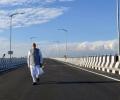
'I say Modi was India's last chance.' 'Because the kind of work this government has done -- I'm talking about physical delivery -- is fantastic, like no time in our history.'

"This is Narendra Modi government, nobody can dilute the AFSPA as we are standing like a rock behind the security forces, protecting (our) border," Shah asserted.

'There is little appetite in the Democratic foreign policy establishment to pick a fight with India.'

As we wave goodbye to 2019, we look back at the highlights of the year, in the numbers that made it memorable.
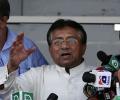
Musharraf, the 74-year-old retired general who is in self-exile in Dubai, said that Mumbai attack mastermind Saeed "is involved in Kashmir" and he supports their involvement.

Article 35-A, which was incorporated in the Constitution by a 1954 Presidential Order, accords special rights and privileges to the citizens of Jammu and Kashmir and denies property rights to a woman who marries a person from outside the state.
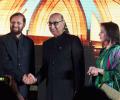
Javadekar was at the event, where presence of his ministerial colleague V K Singh last year had drawn flak from the media, for around 20 minutes, and extended his 'best wishes' to the Pakistani people on the sidelines.
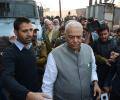
Bharatiya Janata Party leader Yashwant Sinha on Tuesday created ripples as he led a five-member delegation of civil society members to meet separatist leaders Syed Ali Shah Geelani and Mirwaiz Umar Farooq in a bid to break the three-month impasse in Kashmir triggered by the killing of Hizbul Mujahideen militant Burhan Wani.
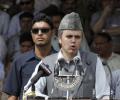
Jammu and Kashmir Chief Minister Omar Abdullah Tuesday asserted that his party would continue its alliance with the Congress party.

'Many people thought that a Hindu nationalist party's government would take bold steps vis-a-vis Kashmir. But sadly their approach has been led by military and security priorities.' 'We would suggest to India that she initiate the dialogue following the Vajpayee model. That is the way forward. Otherwise, there is a looming threat. We are seeing educated youth joining militancy.'
Both countries are closer than before due to these two leaders's public display of mutual connectivity and warm exchanges of words, but how it will help India to serve its interests will be known on Tuesday.

Peoples Democratic Party veteran Mufti Mohammed Sayeed was sworn-in as chief minister of Jammu and Kashmir heading a coalition with BJP which, in a clear departure from its earlier stand, agreed to maintain status quo on Article 370 in the common agenda for governance.
